
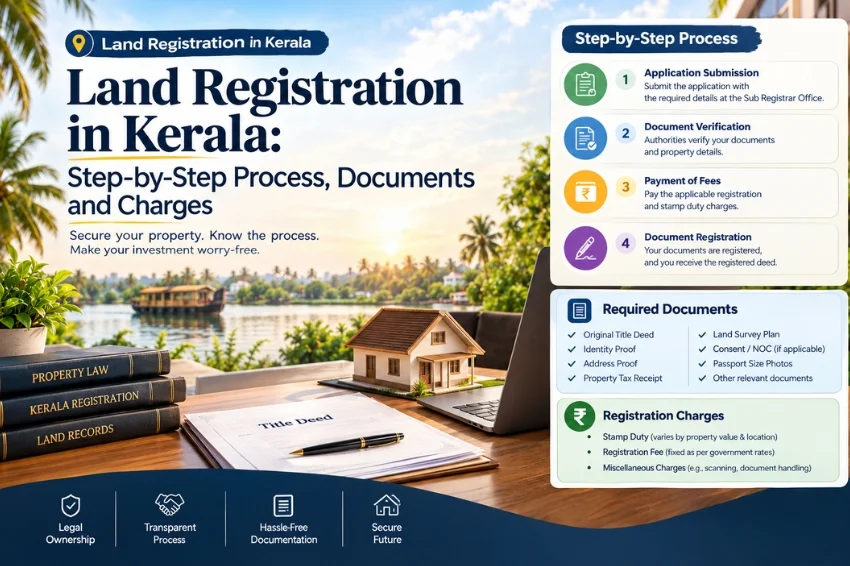
Buying land in Kerala involves more than finding the right location and agreeing on a price. Completing the legal registration process is essential to formally record the property transaction and establish the buyer's ownership rights. Whether you are purchasing residential land, agricultural land or a plot for future investment, understanding the registration procedure can help you avoid unnecessary delays and expenses.
From checking property documents to paying stamp duty and completing registration at the Sub Registrar Office, every stage requires attention. Here is a practical guide to land registration in Kerala, including the required documents, government charges and registration process.
1. What Is Land Registration in Kerala?
Land registration is the legal process of recording a property transaction with the Kerala Registration Department. When land is sold, the buyer and seller execute a sale deed, which is presented before the jurisdictional Sub Registrar Office for registration.
The registered sale deed serves as an important legal record of the transfer. However, registration should not replace proper title verification. Buyers must independently check the seller's ownership, property history and applicable land-related restrictions before completing the transaction.
2. Documents Required for Land Registration in Kerala
Preparing the necessary documents in advance can make the registration process smoother. The commonly required documents include:
Original title deed: The seller's existing registered deed establishing ownership.
Previous title deeds: Earlier ownership documents, where required, to verify the property's ownership history.
Encumbrance Certificate (EC): Shows registered transactions and encumbrances recorded against the property during the selected period.
Latest land tax receipt: Evidence of payment of basic land tax.
Possession certificate: Issued by the Village Office, where applicable.
Location or survey sketch: Helps identify the property's boundaries, survey number and subdivision.
Fair value details: Government-assessed land value used for calculating applicable charges.
Identity proofs: Valid identification documents of the buyer and seller.
Draft sale deed: The document containing the agreed transaction details.
PAN details: PAN or applicable Form 60 documentation, depending on the circumstances.
Additional documents, declarations, building-related forms or permissions may be required depending on the property and transaction. Always confirm the exact checklist with the concerned Sub Registrar Office or a licensed document writer.
3. Land Registration Charges in Kerala
One of the most important expenses when purchasing land is the government registration charge. Buyers should account for both stamp duty and the registration fee when calculating their total property purchase budget.
For a standard sale deed, the commonly published Kerala rates are:
Stamp Duty: 8% of the higher of the property's fair value or sale consideration.
Registration Fee: 2% of the higher of the property's fair value or sale consideration.
This makes the combined government charge approximately 10% of the applicable valuation for a standard sale transaction. Other expenses, such as document preparation and professional fees, may apply separately.
Example: If the applicable property value is ₹50 lakh, the indicative stamp duty would be ₹4 lakh and the registration fee would be ₹1 lakh, making the combined government charges ₹5 lakh.
The actual amount must be confirmed using the latest official fee schedule and the Sub Registrar Office's calculation. Rates, exemptions and special transaction conditions may vary.
4. Step-by-Step Land Registration Process in Kerala
The Kerala Registration Department provides online facilities through its PEARL portal for document registration. The general process involves the following steps.
Step 1: Verify the Property Documents
Before preparing the sale deed, check the seller's ownership documents, encumbrance certificate, land tax receipt, survey details and applicable permissions. Confirm that the property description and boundaries match the available records.
Step 2: Check the Fair Value of Land
Find the government-assessed fair value for the relevant survey number through the official Kerala Registration Department services. Compare it with the agreed purchase price to determine the valuation used for calculating stamp duty and registration fees.
Step 3: Prepare the Sale Deed
Prepare the sale deed with the help of a licensed document writer or advocate. It should clearly mention the buyer's and seller's details, property description, survey number, boundaries, agreed price and other transaction conditions.
Step 4: Complete Online Registration Details
Create or use an account on the PEARL registration portal and enter the required document, property and party details. Select the relevant Sub Registrar Office and book an available registration token or time slot.
Step 5: Pay Stamp Duty and Registration Fees
Pay the applicable government charges through the permitted payment methods. E-stamping is mandatory when stamp duty is ₹1 lakh or above, as specified in the department's registration procedure.
Step 6: Visit the Sub Registrar Office
The parties must present the original deed and required supporting documents at the allotted time. The registering officer verifies the documents, identities and payment details. Photographs, signatures and thumb impressions are completed as required.
Step 7: Complete Registration and Collect the Deed
Once the document is accepted and registration is completed, the registered deed is scanned and returned according to the department's procedure. Keep the original document and payment receipts safely.
5. What Should You Do After Land Registration?
Completing the sale deed registration is an important milestone, but buyers should also follow up on the revenue records.
Apply for Pokkuvaravu (mutation) to transfer the land's revenue records into the new owner's name. This helps update the ownership details maintained by the Village Office and enables the buyer to pay future land tax under their name.
Keep the registered sale deed, updated land tax receipt and other property documents safely. If the transaction includes a building, check whether additional building tax or local body records need to be updated.
6. Important Things to Check Before Registering Land
Before finalising a land purchase, verify the title history, survey boundaries, access road, land classification and applicable restrictions. Check whether the property has pending disputes, registered mortgages or other legal issues.
An Encumbrance Certificate is useful, but it should not be treated as a complete guarantee of clear ownership. Consider obtaining legal advice and conducting a proper title verification before paying the full purchase amount.
Conclusion
Land registration in Kerala requires careful document verification, accurate deed preparation and payment of applicable government charges. Understanding the process before purchasing can help buyers avoid complications and complete the transaction with greater confidence.
If you are planning to buy residential land or an investment plot in Kerala, explore available property listings on Bynsel.com. Compare locations, evaluate property details and complete the necessary legal checks before making your purchase decision.