
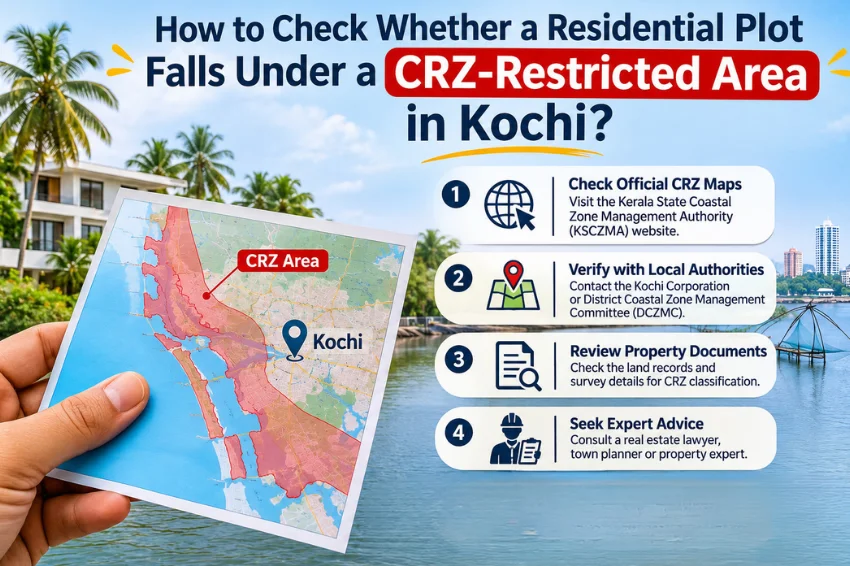
Buying a residential plot near the backwaters, canals or coastal areas of Kochi can be attractive because of its location and surroundings. However, before purchasing waterfront or coastal land, buyers must check whether the property falls under the Coastal Regulation Zone (CRZ).
CRZ regulations are designed to protect coastal ecosystems and regulate development along coastal stretches and tidal waterbodies. A plot may appear suitable for residential construction, but restrictions could affect the type of building permitted, construction activity and development potential.
If you are planning to buy residential land in Kochi, understanding how to verify its CRZ status can help you avoid legal complications and costly investment mistakes.
1. Understand What CRZ Means
The Coastal Regulation Zone refers to designated coastal stretches and associated water areas regulated under the CRZ Notification issued by the Ministry of Environment, Forest and Climate Change.
In Kochi, CRZ regulations are relevant not only to properties near the Arabian Sea but also to certain areas along backwaters, estuaries, creeks and tidal-influenced waterbodies.
The applicable restrictions depend on the property's exact location, environmental characteristics and CRZ classification. Therefore, a plot being close to a waterbody does not automatically mean construction is prohibited. Its status must be verified using the approved Coastal Zone Management Plan (CZMP).
2. Check the Kerala Coastal Zone Management Plan
The most important step is to examine the applicable Coastal Zone Management Plan for the property's location.
The Kerala Coastal Zone Management Authority (KCZMA) publishes CRZ maps and related information through its official website. Buyers can refer to the approved CZMP 2019 maps to understand the classification of coastal areas.
Visit the KCZMA website and locate the Coastal Zone Management Plan 2019 section. Identify the relevant district and map sheet covering the property's location.
The map can help you understand whether the plot falls within a CRZ boundary and which category applies. However, online maps should be treated as a preliminary reference. Exact property-level confirmation may require survey details and verification by the competent authority.
3. Understand the Different CRZ Categories
Under the CRZ Notification 2019, coastal areas are classified into different categories based on environmental sensitivity and development characteristics.
CRZ-I: Includes ecologically sensitive areas such as mangroves, sand dunes, biologically active mudflats and certain protected habitats. These areas have significant development restrictions.
CRZ-II: Generally covers developed coastal areas within existing municipal limits or other qualifying developed areas. Construction is regulated by specific conditions relating to existing development, building lines and applicable permissions.
CRZ-III: Covers relatively less developed coastal areas. These areas may include No Development Zones (NDZ), with restrictions depending on the applicable subcategory and approved plan.
CRZ-IV: Covers specified water areas, including coastal waters and tidal-influenced water areas. Restrictions apply to activities and development within these areas.
The exact construction permissions differ across categories. Buyers should not assume that every CRZ area has the same restrictions or that a particular category automatically permits residential construction.
4. Collect the Property's Survey and Location Details
Before checking the CRZ map, collect accurate details of the plot. A general location or nearby landmark may not be sufficient to identify the property's exact position.
Important details include:
• Survey number and subdivision number.
• Village and taluk details.
• Latest land tax receipt.
• Possession certificate, where available.
• Location sketch and survey plan.
• Exact plot boundaries and measurements.
These details help identify the correct parcel of land on the relevant coastal zone map.
If the plot is close to a backwater, canal or other tidal waterbody, do not rely only on the distance mentioned by the seller. The applicable High Tide Line (HTL), CRZ boundary and other mapped features must be considered.
5. Verify the CRZ Status with the Relevant Authorities
After identifying the property's approximate location on the map, seek confirmation from the appropriate authorities.
You can approach the local municipality, corporation or panchayat and enquire about the property's CRZ status and applicable construction requirements. Depending on the location and nature of the proposal, the Kerala Coastal Zone Management Authority or the relevant district-level committee may also be involved.
Submit the property survey details, site plan and other required documents for verification.
If the map classification is unclear or the plot appears close to a CRZ boundary, request clarification rather than relying on an informal opinion. The competent authority may need to examine the exact survey boundaries and relevant coastal demarcation.
6. Check Whether Residential Construction Is Permitted
A plot falling within a CRZ area is not automatically unusable. However, the permitted activities and construction conditions depend on its classification and applicable regulations.
Before purchasing, confirm:
• Whether residential construction is permitted in the specific location.
• Whether CRZ clearance or other approvals are required.
• Applicable building restrictions and setbacks.
• Whether the proposed building plan meets local building rules.
• Whether any existing structures have valid approvals.
An existing building on the plot does not automatically prove that future construction or redevelopment will be permitted. Verify the approved building plan and relevant permissions separately.
7. Why Should Buyers Complete CRZ Verification Before Paying an Advance?
Purchasing land without checking CRZ restrictions can create difficulties later. Buyers may discover that their proposed house cannot be constructed as planned or that additional approvals and compliance requirements apply.
Such restrictions can affect construction timelines, development costs, financing options and future resale potential.
A plot may also have other restrictions unrelated to CRZ, including wetland classification, land-use limitations or local building regulations. These should be examined separately.
Before signing the sale agreement, make CRZ verification part of your legal due diligence. Consult a property lawyer and, where necessary, a qualified survey professional to review the documents and location.
Conclusion
Checking whether a residential plot falls under a CRZ-restricted area in Kochi is an essential step before purchasing coastal or waterfront land. Start with the approved Kerala Coastal Zone Management Plan, verify the property's survey details and obtain confirmation from the relevant authorities.
Do not depend solely on the seller's assurance, nearby construction activity or the property's current appearance. Proper CRZ verification can help you understand the land's development possibilities, avoid unexpected restrictions and make a more informed property investment.
Looking for residential plots in Kochi? Explore land listings on Bynsel.com, compare locations and property details, and complete the necessary legal and regulatory checks before making your purchase.